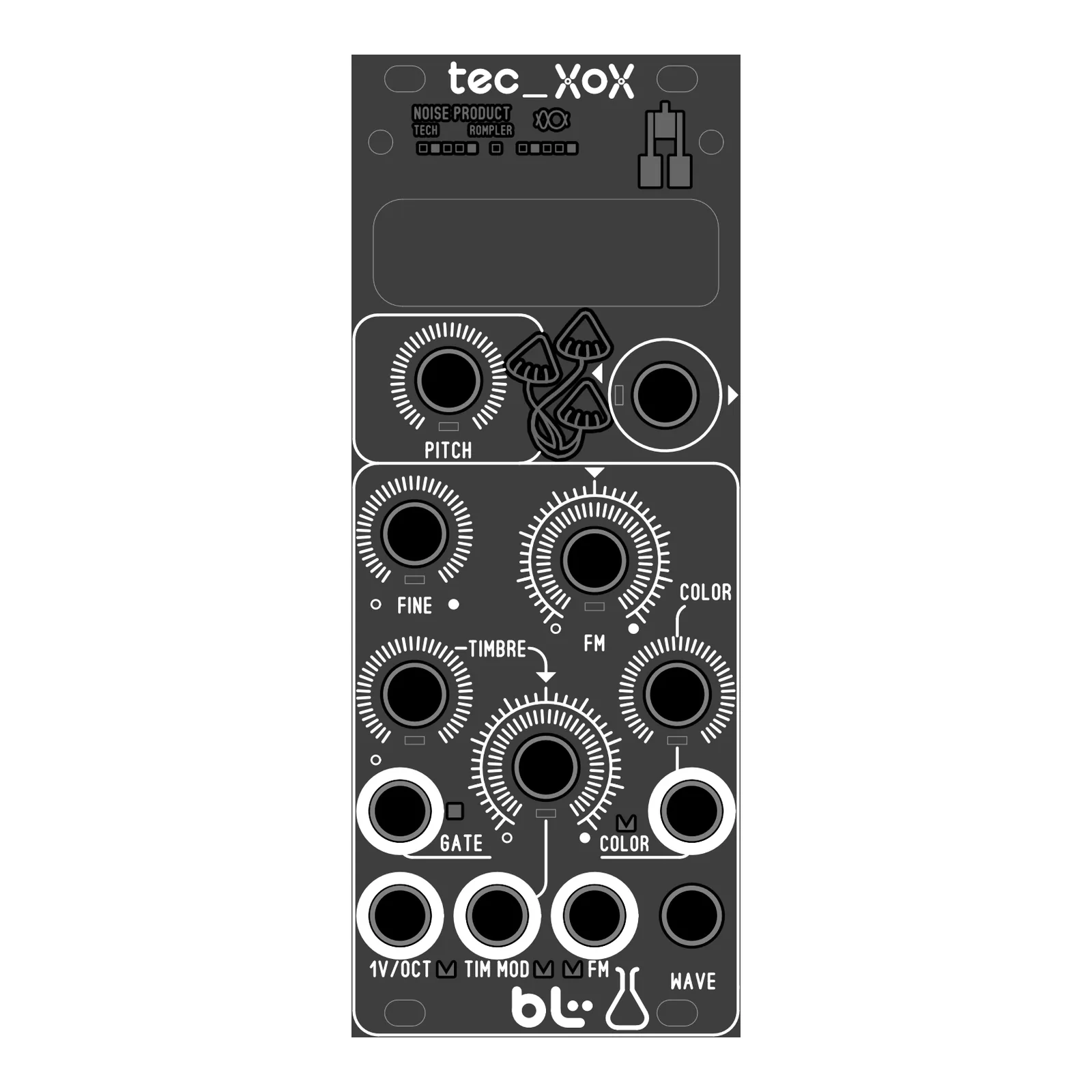
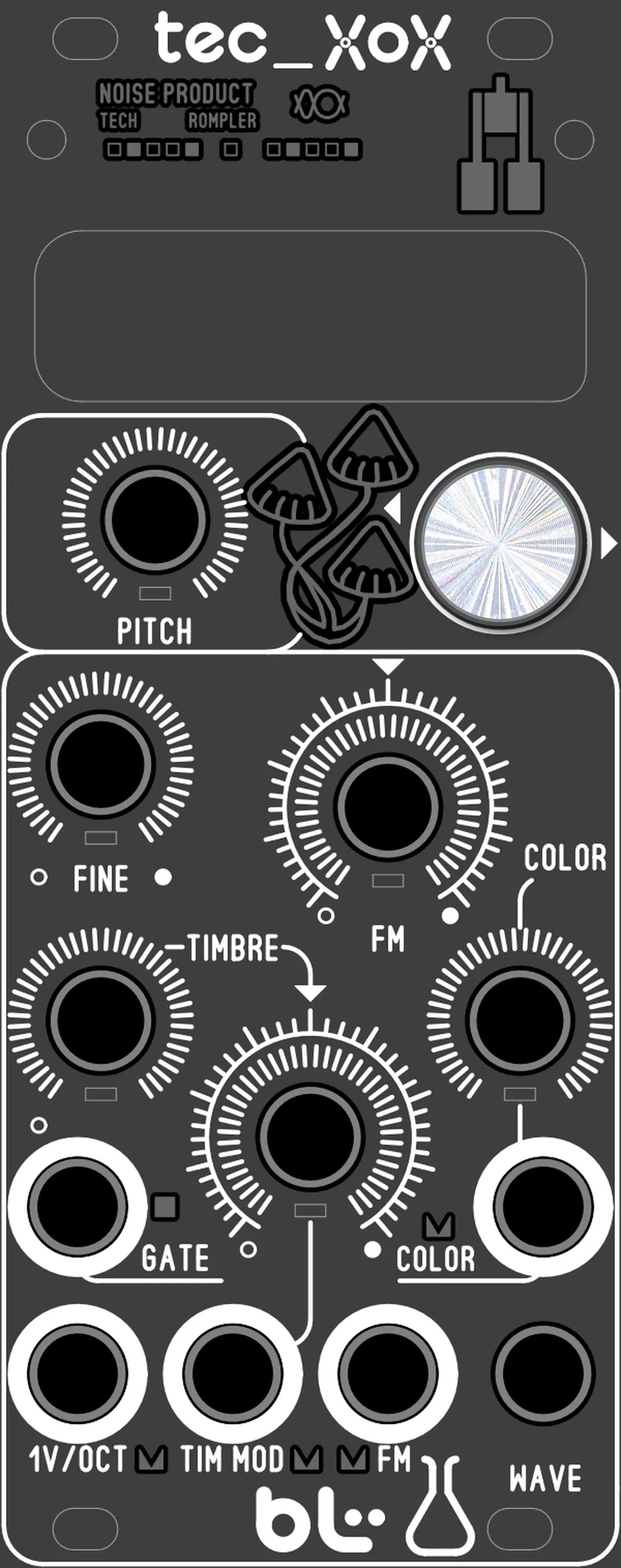
This is the TecXoX's own firmware running in your browser: turn its knobs, play it, and hear the module itself before you order. 56 engines for techno: 26 drums (kicks, 808 boom, 909 punch, toms, congas, snare, clap, rimshot, cowbell, claves, hats, ride, crash, shaker, tambourine, blips, FM drums, glitches, risers, marimba, bells) and 30 voices (acid, Reese, supersaw, hoover, rave stabs, organ, pad, wobble, chip, FM, vowels, sub, dub siren and more). With an ADSR, chorus, ring modulator, echo, drive and filter, and a MORE page with an internal clock, ratchets, probability, swing and an arpeggiator.
Drag a knob up or down (Shift for fine steps), double-click to reset it. The mouse wheel works too.
The clock is running: it starts on KICK, turn the encoder to hear each drum. Voices (GRND onwards, and SUPR onwards) play continuously: play the keyboard and sweep TIMBRE. In the menu: CHOR, RING and ECHO for effects; open MORE for ICLK, RTCH, PROB and ARP. (Presets can't be saved in the demo.)
Trigger and clock
Keyboard to V/OCT and TRIG
V/OCT +0.00 V
Click the demo, then play from your computer keyboard: Z to M and Q to I are notes, the arrow keys turn the encoder, Enter pushes it and Space is TRIG. Esc gives the keys back to the page.
LFO to the CV inputs
The TIMBRE and FM amounts follow the modulation and FM knobs.
Output
The 56 engines
T is what the TIMBRE knob does, C is what COLOR does.
The demo stops making sound after 20 minutes; press Restart to continue. TecXoX includes open-source code by Émilie Gillet (MIT license).
About this module
TecXoX is a techno groove box for Eurorack: drums and synth voices in one module. It has 56 engines built for the dance floor: 26 drum engines that fire from the TRIG input, and 30 voice engines for basslines, leads, stabs, pads, drones and noise.
One encoder and a four-character display give you every engine and setting. On top of the engines, TecXoX has an internal AD or ADSR envelope, a quantizer, bit and sample-rate reduction, built-in effects (chorus, ring modulator, echo, drive and filter) and a second settings page (MORE) with an internal clock, ratchets, probability, swing, an arpeggiator, glide, vibrato, 8 presets and favorite engines.
A complete drum machine: kicks (sine, rumble, 808 boom, 909 punch), toms, congas, snare, clap, rimshot, cowbell, claves, hats, ride, crash, shaker, tambourine, marimba, bells, FM drums, zaps, blips, glitches and risers, all tunable over V/OCT
Bass and lead voices: acid, Reese, sub, wobble, supersaw, hoover, rave stabs, organ, string pad, PWM, sync, FM, vowels and dub chords
Digital weirdness: wavefolding, wrap-around smash, VOSIM, summation, cross-PM, phase-distortion resonance, bit crushing, shift registers, chip waves, crackles and a dub siren
Two knobs that matter: every engine has a main tone control (TIMBRE) and a second dimension (COLOR). For drums, COLOR is almost always the decay
A groovebox in one module: ICLK plays the module with nothing patched; RTCH, PROB, SWNG, TRNT and the arpeggiator turn one engine into a moving pattern
Clean where it counts: band-limited oscillators, anti-aliased folding, wrapping and sync, and pitch-aware limits keep high notes from turning to mush, unless you ask for it
Full 96 kHz rendering
Drums are silent until they receive a trigger: patch a clock or trigger sequence into TRIG, or turn on the internal clock. Your pitch calibration and settings are kept in the module's memory and are not affected by choosing engines.